
“Automatic” always transfers responsibility somewhere.
Automatic printing saves a tap, but it also decides when the store becomes responsible for the order. The setting must match the operational rule.
TJ META'S FLAGSHIP PLATFORM
Website, ordering, reservations, staff screens, printers, rewards, payments, and billing all describe the same business. Vookme was built so they can share the same rules instead of constantly reconciling afterward.
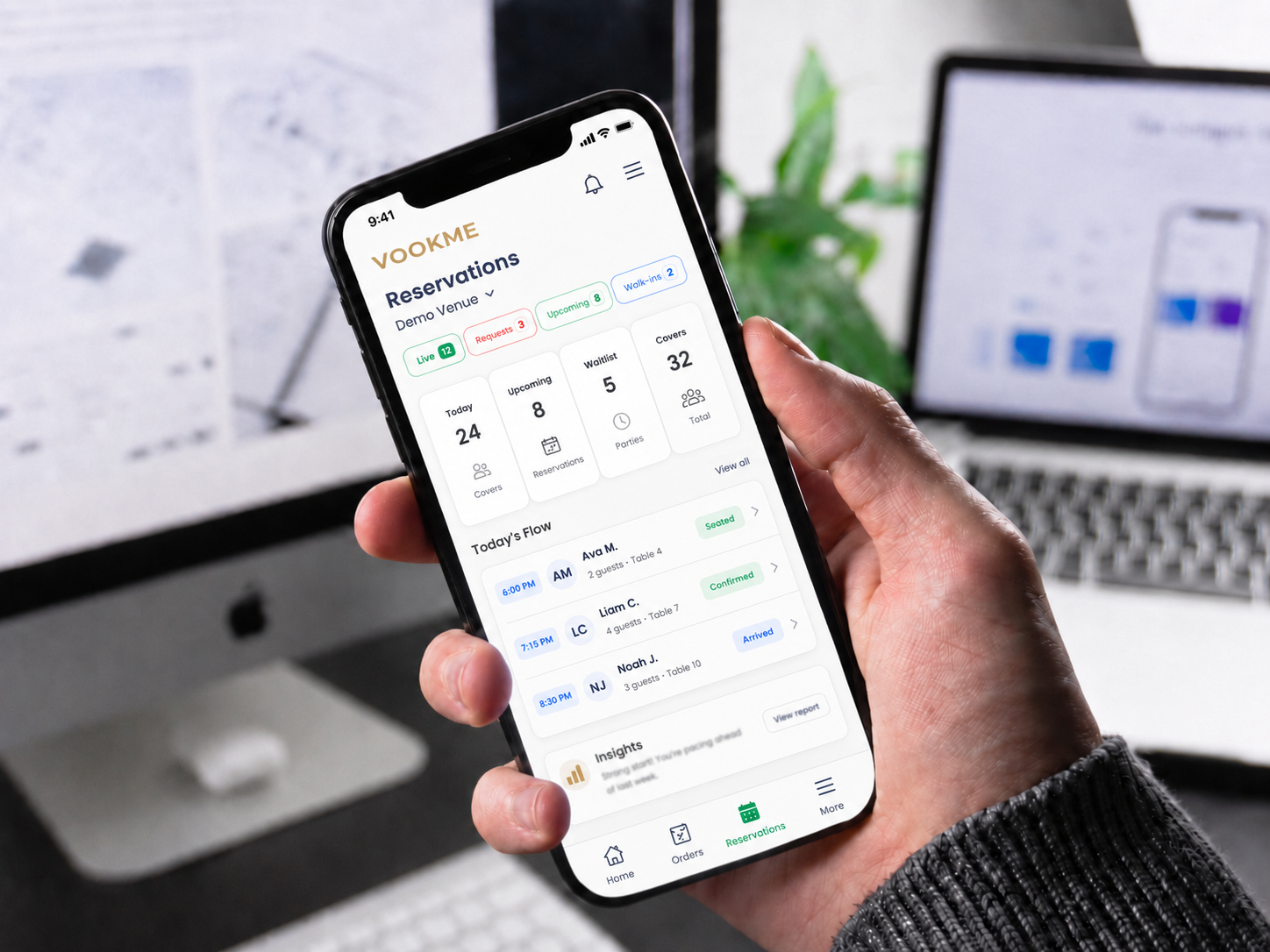
Illustrative image. Current product demonstrations are available through Vookme.
WHY IT EXISTS
A small business can have a modern website and still receive an order in a system the staff rarely watches. It can offer rewards that do not recognize the same customer who just ordered. It can accept a reservation without accounting for how the business actually staffs the day.
None of those tools are necessarily bad. They are just solving their own part. The business is left to reconcile the gaps with extra tablets, duplicate menu edits, screenshots, phone calls, and memory.
Vookme started with the belief that customer actions and store operations should share context. That sounds obvious. It becomes difficult the moment a real printer, payment provider, staff decision, delayed order, offline device, or customer identity enters the flow.
ONE OPERATIONAL MODEL
Vookme is not a claim that every business should use every feature. It is a way to keep the enabled features from contradicting one another.
Store information, menus, services, hours, ordering, reservations, and customer actions managed from shared business data.
Immediate and scheduled orders, pay-in-store or online payment, staff review rules, kitchen timing, and customer status updates.
Restaurant and service-business scheduling built around capacity, time slots, staff availability, check-in, and operational status.
Operational devices connected to order rules, readiness checks, recovery paths, and clear failure visibility.
Phone-verified customer access, rewards, wallet history, claim and redeem flows, reorder, promotions, and shared ledger logic.
Fast customer entry points for ordering and rewards, tied back to the same business rules used across the platform.
Current order updates, dashboard alerts, staff decisions, preparation status, and recovery when a long-running screen falls behind.
Customer payments, recurring store billing, failure handling, tax settings, and store-level settlement rules.
Store ownership, roles, partner assignment, revenue sharing, administration, and reporting without merging one store's state into another.
WHAT BUILDING IT TAUGHT US
These are not marketing points. They are decisions that came from watching the same workflow fail in several different ways.
Automatic printing saves a tap, but it also decides when the store becomes responsible for the order. The setting must match the operational rule.
The application may know a job was delivered to a device. Staff still need a clear path when paper did not come out or the receipt is unusable.
Reorder, scheduled ordering, tap-to-order, and rewards are useful only if the resulting order remains obvious in the same staff workflow.
A store dashboard may stay open for months. It needs reconnect, refresh, stale-state detection, and recovery without asking staff to understand the transport layer.
Different customer entry methods can require different trust checks. Once verified, they should use the same order, reward, ledger, validation, and audit rules.
WHY VOOKME MATTERS TO TJ META CLIENTS
Vookme combines public websites, verified customer flows, store dashboards, live operations, connected devices, payments, recurring billing, scheduled work, and multi-store data.
A custom project may need only two of those pieces. The value is that we have seen how those pieces behave when they are no longer isolated. We know the questions to ask before an integration becomes the next fragile dependency.
See other project experienceTHE PRODUCT IS STILL EVOLVING
Store behavior exposes assumptions quickly. We test, observe, remove unnecessary steps, and protect the parts already working. That last part matters. Improvement is not permission to rewrite a stable flow every time a new idea appears.
The same discipline carries into client work: make the change that solves the verified problem, then leave the rest of production alone.

INTERESTED IN VOOKME?
Vookme inquiries and custom development conversations are both welcome.